

This month, Women’s Health published a long, serious, carefully reported feature on lipedema: “This Condition Is Often Mistaken for Obesity. But Diet, Exercise, and Medication Won’t Fix It” by Amy Wilkinson.
If you can get to it, read it. It’s worth your time.
If you’ve hit a paywall — it ran in Apple News and access varies — here’s what it said, and what we’d add. Because the parts that matter shouldn’t sit behind a subscription.
We have been doing this work since 2013, back when most doctors couldn’t pronounce the word. We have watched a lot of articles come and go. This one is better than most, and it is worth saying exactly why — and then saying what it left in the shadows.
What it got right
It named the misdiagnosis machine.
The piece opens with Aisha Durham, a communication professor at the University of South Florida, being told across multiple appointments that she had an autoimmune disorder, then fibromyalgia, then a spider bite, then an allergic reaction, then simply that she was fat. None of it was true. All of it took time she does not get back.
That is not an unusual story. That is the standard one. The article reports an average of about ten years from symptoms to diagnosis, and an average age at diagnosis of 48. Read that again. Half of the women who eventually get an answer are past their mid-forties when they get it.
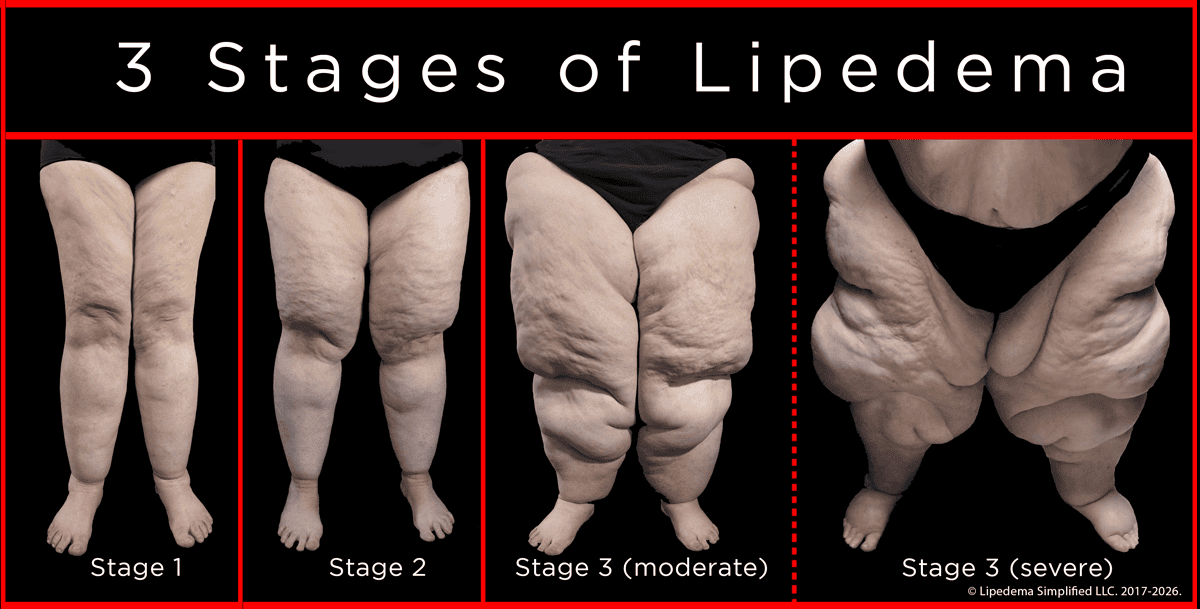
It refused the weight-loss framing.
The headline does the work that a decade of patient advocacy has been trying to do: diet, exercise, and medication won’t fix it. Lipedema fat does not behave like other fat. It does not respond to caloric restriction in the way the entire apparatus of women’s health assumes all fat must. Women at any BMI can have it.
The article follows one woman, identified as Caroline, through bariatric surgery, multiple commercial weight-loss programs, a medically supervised program, and a GLP-1. She lost a great deal of weight. Her lower body did not change. Her line about it — “I have had a doctor-prescribed eating disorder for my entire adult life” — is the most important sentence in the piece.
We want to sit with that one for a moment, because it is not hyperbole and it is not rare. A significant portion of the women who find us have spent years being prescribed restriction by people who meant well and were looking at the wrong thing. The damage from that is not only physical.
It took the insurance nightmare seriously.
Most coverage stops at diagnosis. This one kept going into the part that patients actually spend their lives on. Kasi Grosvenor, who has had five surgeries, describes a four-hour functional capacity exam demanded by her insurer to prove her lipedema was affecting her life, and says she “worked harder for my insurance than my capstone for my master’s degree program.” Caroline’s 2025 out-of-pocket total for uncovered lipedema care was $130,000, with no certainty of reimbursement. She eventually traveled abroad for surgery because it was cheaper than the American health care system.
That is the reality of this condition in the United States, and it almost never makes it into print.
It reported the diagnostic code, which is genuinely news.
The World Health Organization classifies lipedema as a distinct disease in ICD-11. The United States still runs on ICD-10, which does not include it. Without a code, there is no clean way for an insurer to authorize treatment, no reliable way for researchers to count how many women are affected, and no straightforward path to funding.
The article reports that the CDC has approved a dedicated lipedema code taking effect in October 2027. That matters more than it sounds. As Sarah Whitehead, an advanced registered nurse practitioner quoted in the piece, puts it: “It lets us count how many women are affected and make a real case for research funding.”
What it left out
None of this is a criticism of the reporting. It is a good article. But there are things a magazine feature structurally cannot do, and they happen to be the things that determine how the next twenty years of your life go.
Every woman in that article found her answer outside the exam room.
Look at how the diagnoses actually happened. Durham found a scholarly video presentation on YouTube and recognized her own legs in the photographs. Caroline found the word lipedema on a subreddit at night. Not one of them was handed the answer by a physician in a scheduled appointment.
That is the real finding buried in this piece, and the article doesn’t quite draw it out: for lipedema, patient knowledge has been running ahead of clinical knowledge for years. The information travels through communities before it travels through medical schools. That is why community is not a consolation prize in this condition. It is the primary distribution system for the knowledge that changes lives.
The article ends at diagnosis. Life doesn’t.
The piece closes by pointing readers toward a provider directory, which is a reasonable place to send someone who suspects they have lipedema. But a diagnosis is a Tuesday afternoon. What follows is decades.
Decades of compression, of movement that helps rather than hurts, of anti-inflammatory eating that isn’t a punishment, of deciding whether to pursue surgery, of appealing denials, of explaining yourself to new doctors, of grieving what you were told about your body, and of finding out that other people are living the same day you are. Grosvenor says she uses more than fifty treatment modalities on an ongoing basis and dedicates one to two hours a day to the condition. That is the actual job.
Nobody does that job well alone. Almost nobody does it well from an article.
The emotional toll gets a section. It deserves a strategy.
The article is honest that body image “frequently plummets” and that years of dismissal leave marks that outlast surgical scars. What it cannot offer is what to do about that. Being believed, in a room full of people who already understand, does more for that than any single intervention we have seen in over thirteen years of this work. It is also the one thing you cannot buy from a clinic.
Where we come in
We are Lipedema Simplified and Lipedema Project. We have been building lipedema education and community since 2013 — first through expert summit interviews, and since 2020 through the Heart to Heart conferences. This October is our 13th conference event.
We are not a surgical practice. We do not have a procedure to sell you. What we have is the accumulated knowledge of a global community that has been figuring this out together for years—through our TRIBE community, our educational programming, and the conversations that happen between sessions.
If the Women’s Health article was the first time you saw your own body described accurately, welcome. You are not imagining it, you are not lazy, and you are very much not alone.

Our conference is in October, and you should come
The Lipedema and Lymphedema Heart to Heart Event runs October 23–25, 2026, entirely online. It’s our 13th conference.
Three days of global expert speakers, breakout discussions, and wisdom-sharing circles — the kind of small-group conversation where someone says the thing you thought only you experienced. Patients, clinicians, caregivers, and researchers in the same virtual rooms.
General Access includes all three days live. Premium Access adds extended Q&A sessions and a replay hub with every recording, which is what most people choose once they look honestly at their own October weekend.
Register for Heart to Heart 2026 →
The article said it takes ten years to get a diagnosis. It doesn’t have to take ten years to find your people.
[If you or someone you know is struggling with the emotional weight of a lipedema diagnosis or a long history of being dismissed, please consider reaching out to a mental health professional who works with chronic illness. Our community can offer recognition and solidarity; it isn’t a substitute for clinical support, and both are worth having.]